


Amazon: https://onelink.to/lean-health-plan
How the Medical Claim Was Used to Hijack Healthcare
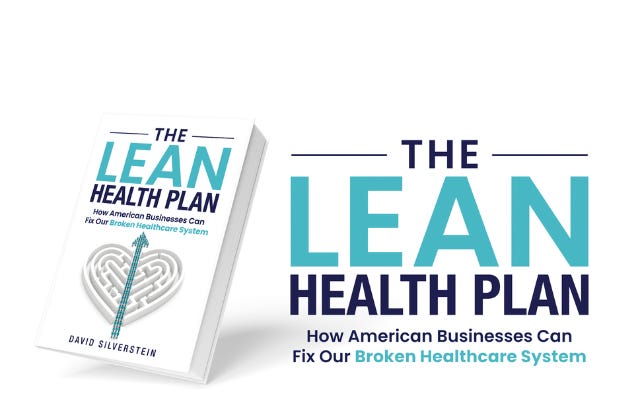
In my new book, The Lean Health Plan, I explore one of the most baffling paradoxes in modern business: how corporate America completely abandoned its knowledge of supply chain management when it comes to healthcare.
Employers who ruthlessly optimize the procurement of steel, software, and logistics services somehow bought into a crazy, backwards system for purchasing medical care. But the tragedy goes far beyond corporate balance sheets. By blindly accepting this flawed model and defying everything they know about procurement, corporate America has forced everyday Americans to suffer as a result of their mismanagement.
Corporate America broke the system, and in The Lean Health Plan, I explain why only corporate America can save it.
For 95% of medical events, healthcare is not a catastrophic mystery; it is a predictable, everyday matter of consumerism or corporate procurement. Yet, both businesses and Americans have surrendered to the Big Healthcare bureaucracy.
The weapon that enabled this hostile takeover—and the root of all nearly all dysfunction in our healthcare supply chain—is the medical claim.
Bureaucratic Artifact
The first thing we need to do is fix our language: a “claim” is not a clinical event. It is a bureaucratic artifact created by an abusive payment system that is designed to extract money without returning anything of value. Claims are just the tool of extraction.
Medical coding is not necessary to produce procurement data. We do not have coding systems for any other part of our supply chains. We just have simple data.
Have you ever looked at the claims cycle? It’s the craziest thing you can imagine.
Here’s just some of it:
1. Eligibility and Coverage Verification
2. Prior Authorization Triage
3. Copay Collection
4. Care & Clinical Coding
5. Clearinghouse Transmission
6. Payer Adjudication
7. Repricing
8. EOB Production and Mailing
9. Final Billing
10. Payer Payment
11. Patient Payment
Then there are denials, appeals, and don’t forget the added mental health issues because everything above adds to the stress of daily life.
All for an annual wellness exam, or well-child visit, or a strep throat?
Oh, and don’t forget that after all of the above is done, all of your data gets aggregated by data brokers. They sell it to pharmaceutical companies, medical device firms, researchers and others. The process is called, “Data Monetization.” Sure, don’t worry—it’s “de-identified,” but it’s still your data that is being sold, often many times over. While a hospital or claims clearinghouse takes a revenue share on the sale of your data that they provide to data brokers, employers and patients don’t see a penny of that revenue. It’s the final tollbooth after all of the other tolls have been paid.
In any other sector of the economy, businesses generate purchase orders, receive detailed invoices, and pay their bills. You do not send your company’s travel expenses to a third-party “expense adjudicator” that takes a percentage of the spend, rewrites the rules midstream, and then tells you what you are “allowed” to reimburse your employee.
Healthcare is the only major category of corporate spend where we have normalized outsourcing the simple act of paying a bill to an industry that negotiates their own prices, imposes its own fees, and hides the details from us.
Americans are Highly Capable Consumers
The American economic is often referred to as a “consumer” economy. Americans are highly proficient consumers.
Our healthcare system defends the claim by arguing that healthcare is uniquely unpredictable. But we do not need complete certainty to distinguish between a truly insurable catastrophic event and everyday purchasing.
At 5 PM, I often don’t know if I’m eating in or dining out, where we might go to dinner, or what I might order. If a couple of my kids are home, that dinner costs as much as a trip to the doctor. Somehow, we manage despite the uncertainty.
We often don’t know exactly which routine trip to the mechanic for an oil change will result in being told we need new brakes, or tires. We don’t know exactly what day the garbage disposal under the kitchen sink will burn out and need replacing. We don’t know when the A/C will fail. And yet we manage these routine, moderately unpredictable expenses without a sprawling claims bureaucracy.
The current model fundamentally underestimates the American consumer. The average American makes it through life successfully navigating complex daily realities—buying groceries, keeping the lights on, and filling up their cars with gas. How is it that we have convinced ourselves they are incapable of simple medical procurement? Instead of funneling money through a bloated administrative tollbooth, why not simply give that $120 directly back to the employee in their paycheck and let them pay for a dentist appointment on their own?
We Can’t Keep Putting Bandages on a Profoundly Broken System
You cannot optimize a system that is built on the wrong model. The only way to win is to adopt a new architecture and a new culturable paradigm that stops insuring everyday maintenance and starts procuring high-performance healthcare.
We must starve the toll collector—my word for the administrative points of extraction that I use throughout the book.
As I outline in The Lean Health Plan, it is time to end the claim, and in doing so, end the administrative empire it built. Employers have the power, the capital, and the moral imperative to tear down this system. By treating healthcare like the supply chain it actually is, corporate America can reduce its healthcare spend by as much as 50% and rescue America from the impending financial disaster that is coming if we don’t act.
I hope you enjoy the book!