



For years, the giants of the healthcare industry—UnitedHealth Group, Cigna, and the rest of the BUCA cartel—have sold self-insured employers on a compelling narrative: vertical integration. The pitch is that bundling your Third-Party Administrator (TPA), Pharmacy Benefit Manager (PBM), and stop-loss insurance under one massive corporate umbrella creates a seamless, efficient, and cost-effective ecosystem.
The reality is a masterclass in wealth extraction. By eliminating independent oversight, the full BUCA Administrative Services Only (ASO) model ensures that all independence is lost, and the plan sponsor is left holding the bag.
Independence eliminates conflicts of interest before they occur, reducing the need for layers of expensive oversight, audits, and utilization controls. When a company cannot steer patients to providers it owns, adjudicate the resulting claims, and profit from both sides of the transaction, there is no behavior left to police. Even prior authorization could be significantly reduced. Much of today’s administrative machinery exists because the same corporate family can influence the referral, control the payment decision, and capture the revenue. Separate those functions and most of that machinery becomes unnecessary.
The concentration of power held by the BUCAs received national attention during the September 20, 2026, episode of Last Week Tonight with John Oliver. Oliver devoted the episode to UnitedHealth Group, portraying the company as an algorithmically driven system whose sprawling control across healthcare allows it to deny care while profiting from nearly every part of the transaction. His takedown was entertaining, but the underlying point was deadly serious: vertical integration is not merely making healthcare bigger, it is making accountability disappear.
A masterclass in conflicted interests
To see how this lack of independence weaponizes your own plan against you, look no further than Katy Talento’s recent, brilliant teardown of a landmark ERISA case. I highly recommend subscribing to her Substack feed for this kind of relentless, razor-sharp advocacy in which she repeatedly exposes the systemic rot inside these mega-carriers.
Katy dissects a federal court ruling involving Scentsy and Blue Cross of Idaho (BCI). Scentsy operates a self-funded plan, and BCI served as its TPA, meaning they adjudicated and paid the claims out of Scentsy’s bank account. BCI also sold Scentsy their stop-loss insurance, the reinsurance policy designed to protect the employer from catastrophic, million-dollar claims.
When a critically ill baby on the plan generated a $1.4 million hospital bill, the stop-loss coverage window was ticking down. BCI, wearing its TPA hat, somehow managed to delay processing the claim until just after the stop-loss window closed. Then, BCI, wearing its stop-loss hat, denied the reimbursement because the claim was “late,” leaving Scentsy on the hook for the entire $1.4 million out-of-pocket.
As Katy rightly points out, when your carrier serves two masters, they will always prioritize the one writing their own profit checks. Scentsy sued and won. The federal judge recognized the glaring fiduciary conflict of interest. However, all employers need to realize the Scentsy case isn’t a one-off anomaly; it is a symptom of a much larger, highly profitable disease.

Where independence goes to die
The Blue Cross of Idaho case is the perfect microcosm of the fully bundled BUCA ASO model. Keep in mind, that the loss of independence is not a defect in these vertically integrated systems; it is what makes the business model work.
Without independence, these are the unavoidable conflicts employers invite:
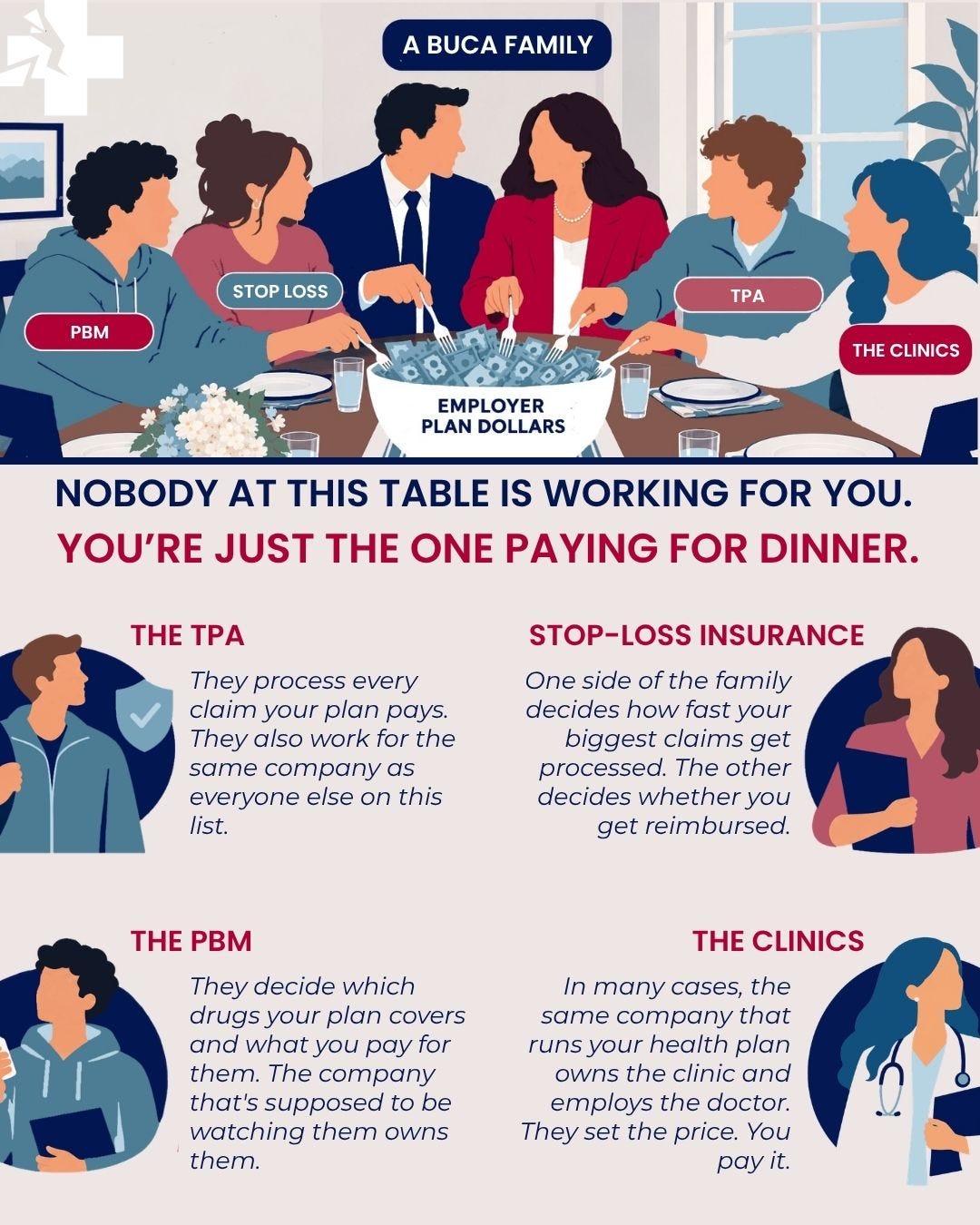
The TPA / Stop-Loss Conflict: Just as Katy highlighted, the entity controlling the speed of your claims processing is the very same entity that profits if the clock runs out on your coverage.
The TPA / PBM Conflict: When UnitedHealth's UMR administers a plan using its own OptumRx, or when Cigna administers a plan using Evernorth, there is no independent oversight demanding transparent drug pricing, tracking pharmaceutical rebates, or determining whether the medication was worth the cost. The TPA will never meaningfully audit its own sister company.
The TPA / Provider Conflict: As UnitedHealth and others aggressively buy up primary care practices, surgical centers, and physician groups, they now adjudicate claims submitted by their own doctors. They are essentially paying themselves with your money, deciding their own reimbursement rates with no independent referee on the field.
The unbundled imperative
Fiduciary duty, the highest obligation known to the law, requires putting the plan and its participants first. It requires undivided loyalty. By definition, undivided loyalty is impossible in a vertically integrated, heavily bundled ASO model where a single corporation sits on every side of the transaction.
Fixing a broken health plan requires reclaiming your independence. Employers must carve out their stop-loss insurance and buy it from an unrelated entity with no financial ties to the claims administrator. They must hire independent, transparent TPAs who have no financial incentive to approve fraudulent or inflated claims. They must partner with pass-through PBMs who don’t profit from the spread on specialty medications.
The illusion of the “seamless” BUCA model is that it makes healthcare easier for the employer. In reality, it only makes it easier for the carrier to hide their margins. True fiduciary responsibility demands independence, and until employers demand it back, the cartel will continue to win.