



I will soon be publishing a book that explains the American healthcare system in ways you’ve likely never had it explained before. The book primarily addresses employers, but it explains the dysfunction of our healthcare system across the board. It also does something other books don’t: it tells you what to do about it. If you’d like to preview a copy, please write to me at David.Silverstein@AmazeHealth.com. All I ask for is your honest feedback.
Note to readers: Names and identifying details about the people and companies in this article have been changed to protect the privacy of those involved. (Or have they?)
A rational decision to go uninsured
Daryn is a 36-year-old father of two, ages 7 and 9. He makes about $120,000 a year as a gig worker, doing graphic design, marketing, and communications.
Last November, during ACA open enrollment, Daryn and his wife sat down to make a decision. His income fluctuates, which made estimating subsidies uncomfortable. Get it wrong, and they could face a clawback at tax time.
They took a hard look at the numbers.
The benchmark silver plan came in at nearly $20,000 a year. Even after subsidies, they were still looking at over $10,000 in premiums, plus a meaningful deductible. Everyone in the family was healthy. No medications, no specialists, no chronic conditions.
Like any rational buyer, they assessed the risk and they decided to pass.
They opted to go uninsured for the year. If something changed, they figured they could always sign up during the next open enrollment.
When the risk becomes real
In January, everything changed.
Their nine-year-old daughter came down with what looked like a routine stomach bug, but instead of recovering, she became lethargic. They took her to the emergency room. Within hours, doctors determined she was in acute kidney failure.
She was diagnosed with Atypical Hemolytic Uremic Syndrome, an extremely rare condition where the immune system, triggered by a common infection, begins attacking the body’s own organs.
She was moved to the pediatric ICU. The care team acted quickly and administered emergency doses of Soliris, a biologic drug that can stop the progression of the disease.
The treatment worked. Her condition stabilized, but the nephrologist delivered the next reality: to keep her kidneys functioning, she would need ongoing infusions of the drug every two weeks, indefinitely.
The cost of outpatient Soliris is measured in hundreds of thousands of dollars a year. Without insurance, Daryn was facing immediate and total financial collapse. So, he adapted.
A rational response to an irrational system
Daryn identified employers offering Day‑1 health benefits. Amazon was one of them. Despite earning the equivalent of $60 an hour through his freelance work, Daryn took a full-time warehouse job paying $19 an hour.
He worked 40 hours a week at Amazon while continuing his freelance business at night.
Because he was hired while his daughter was still hospitalized, he was enrolled immediately in the company’s health plan. By the time she was discharged, the transition was seamless. The new network picked up the case, and the biweekly infusions continued without interruption.
The crisis was contained.
The COBRA exit and the ACA handoff
Once his daughter’s care stabilized, Daryn ran the numbers again.
The math was straightforward. His freelance work was still far more valuable than the warehouse job. Staying employed just to receive the employer-paid subsidy on his health insurance no longer made sense.
So, after 90 days, he quit.
He elected COBRA, paying roughly $2,000 a month to continue the same coverage. On paper, that looks expensive. In reality, it’s a fraction of the cost of the treatment his daughter requires.
Because the plan was self-funded, the claims, hundreds of thousands of dollars per year, are paid out of the employer’s risk pool. The insurance company administers the plan, but it isn’t taking the risk.
Over the next 18 months, Daryn will continue to pay his premiums under COBRA while his former employer covers the claims.
Then COBRA will end.
That event will trigger a special enrollment opportunity. Daryn will then have the chance to move his family onto an ACA plan. The plan will be required to accept his daughter, cover her condition, and continue the treatment.
The cost moves again, this time into the broader individual market.
Who bears the risk?
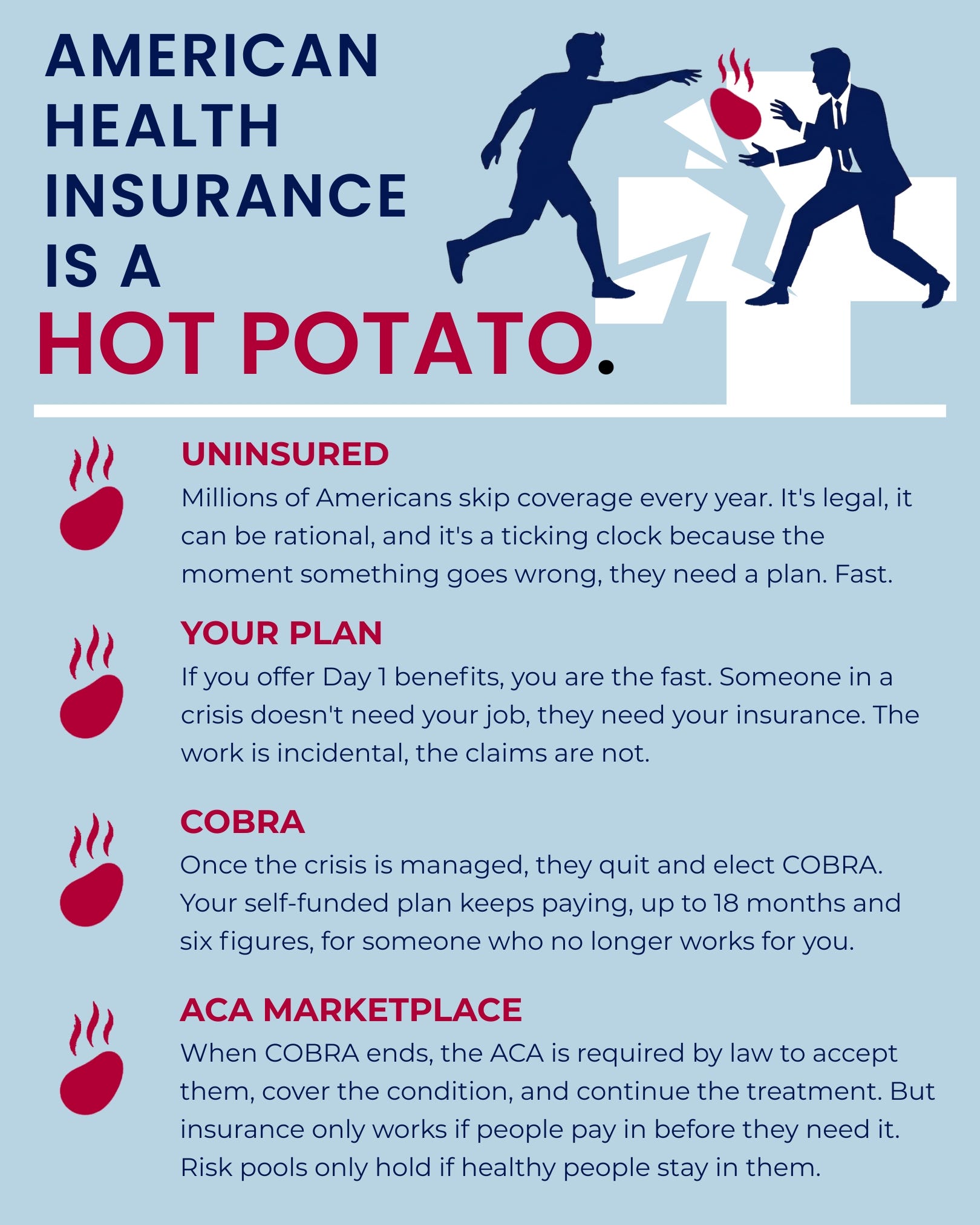
Faced with a catastrophic diagnosis, Daryn found a path that preserved his daughter’s care and avoided financial ruin. But step back, and something else becomes clear. He never bore the catastrophic risk himself.
He declined coverage when the risk appeared low, he entered a risk pool the moment the risk became real, and he will transition to another pool once it is advantageous to do so.
Every step he took was rational, and every step the system allowed.
A fragile assumption
Insurance only works if people pay into it before they need it. Risk pools only hold if healthy individuals remain continuously enrolled. The entire structure assumes a level of pre-commitment that individual incentives undermine.
What Daryn did isn’t an edge case.
Most versions of this behavior are smaller and harder to see, but the underlying dynamic is the same: individuals respond to price signals and timing, while the system depends on their indifference to both.
The result is a quiet tension at the center of American healthcare.
The protection is the problem
The laws are designed to protect people from catastrophe, and they do without question. However, those same protections also make it possible to defer participation until the moment protection is needed.
From Daryn’s perspective, skipping coverage wasn’t reckless. It was a rational calculation that, in the end, held.
From the system’s perspective, it’s a glimpse of something more fragile.
A system that works best when people behave irrationally, and still functions when they don’t, but absorbs the cost either way.