


The next decade may see a shift from “utilization management,” a truly awful process that most of us know as “prior authorizations,” to “formulary management,” a mostly alien concept today.
I’ll write more about why utilization management is in its final days next week. Formulary management is what I want to discuss today.
The AI-powered blockbuster pipeline
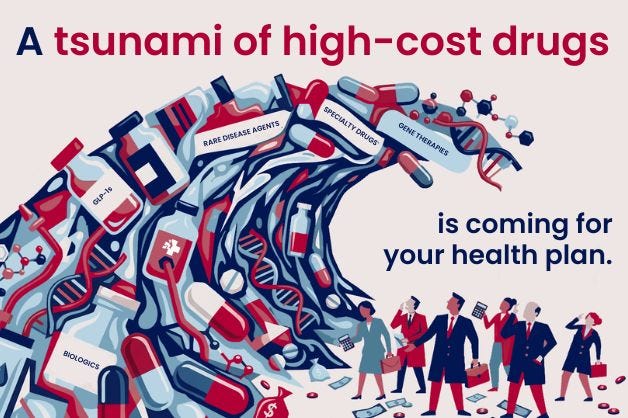
We are no longer just dealing with a slow trickle of specialty medications; we are facing a tsunami of high-cost blockbuster drugs, fueled by a fundamentally faster development cycle.
Artificial Intelligence has moved from a buzzy research concept to a measurable production engine. Today, multiple AI-designed drug candidates, where algorithms drove both the target identification and the generative chemistry, are already in late-stage Phase II and III clinical trials. Couple this AI-accelerated pipeline with the explosion of the GLP-1 market, which has now expanded from injectables into mass-produced daily weight-loss pills, and the volume of new, highly desired medications hitting the market over the next few years is staggering.
The squeeze play of rebates, reps, and TV ads
Scientific innovation is only half the story. The other half is the relentless, well-oiled marketing machinery designed to force these blockbusters through the system and directly onto your balance sheet.
Here is how the modern pharmaceutical playbook works:
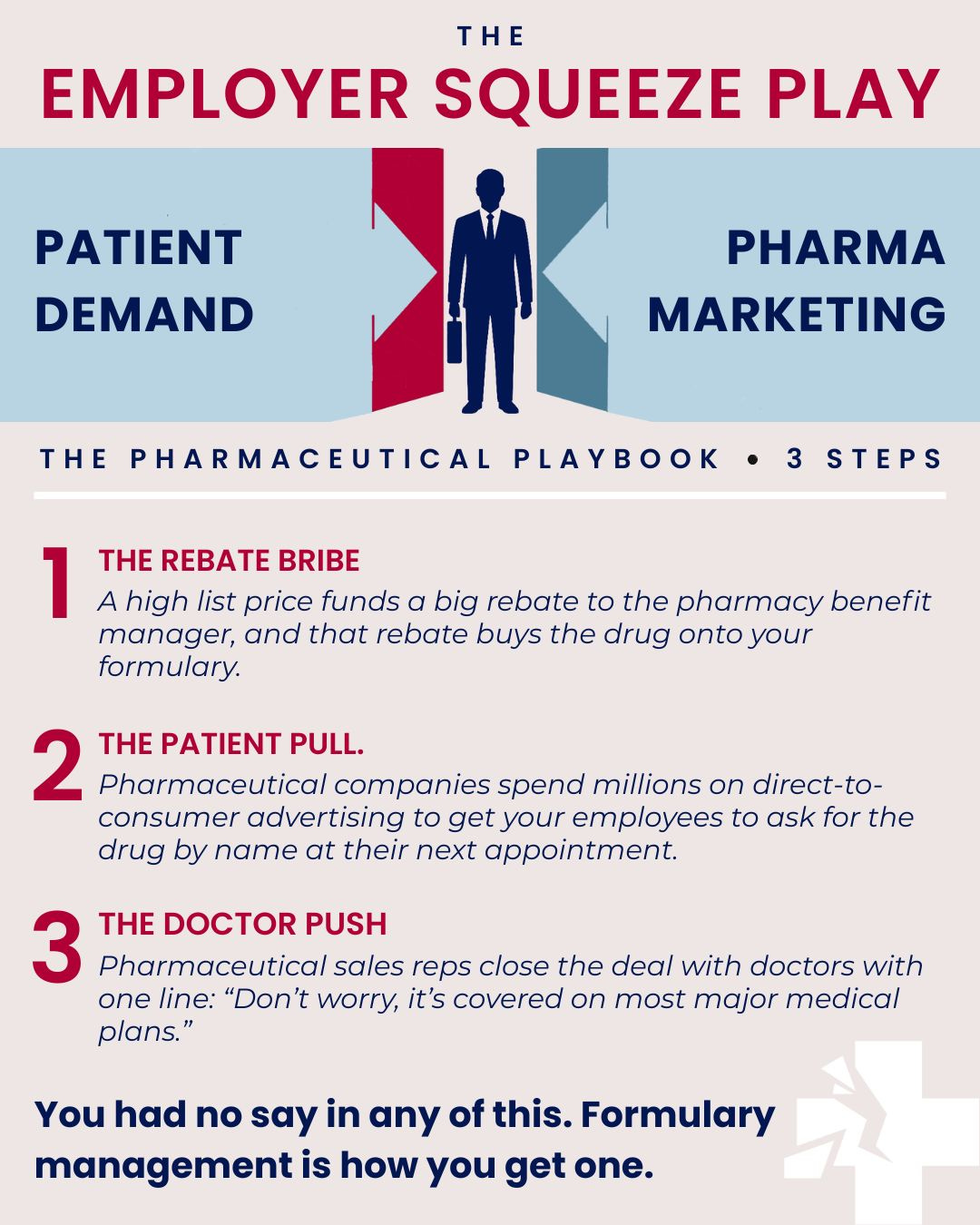
The rebate bribe: Manufacturers set artificially high list prices so they can offer massive rebates to Pharmacy Benefit Managers (PBMs). These rebates effectively “buy” the drug’s way onto standard, off-the-shelf PBM formularies.
The patient pull: With formulary coverage secured, pharma spends millions on direct-to-consumer television advertising. The goal is to bypass the clinical discussion and entice the patient to demand the drug by name.
The doctor push: Simultaneously, pharmaceutical reps flood medical clinics to entice the doctors. The reps come armed with the ultimate closing line: “Don’t worry, it’s covered on most major plans.”
The loop is closed. The manufacturer has ensured the drug is heavily demanded by the patient, easily prescribed by the doctor, and automatically covered by every company’s PBM.
The fear baiting of formulary control
How is a self-insured employer, the entity footing the bill, supposed to manage this onslaught? The answer requires changing the formulary itself. You must literally remove brand-name blockbuster drugs from your formulary altogether in favor of generics and biosimilars.
However, this is exactly where the industry deploys its most effective weapon.
As FDR famously said, “the only thing we have to fear is fear itself.” The healthcare industry is riddled with fear-baiting. In the case of the formulary, brokers and vendors weaponize the fear that if you exclude drugs, someone will be denied a medication they genuinely need.
It is an entirely unfounded fear. Remember, as a self-insured employer, you have the ultimate control. Go read your plan documents. Your TPAs, claims administrators, and brokers all disavow responsibility for anything—in writing. You sign off on those contracts, accepting all responsibility as the named plan fiduciary.
Because you hold the liability, you hold the power. You get to make the decisions.
How to manage exceptions as the insurer
Suppose you strip a high-cost specialty drug from your formulary because there are perfectly adequate, much lower-cost biosimilars available. Then, suppose one of your employees is the one-in-a-million case where an inert element in the biosimilar causes a severe reaction, and they truly need the original name-brand drug.
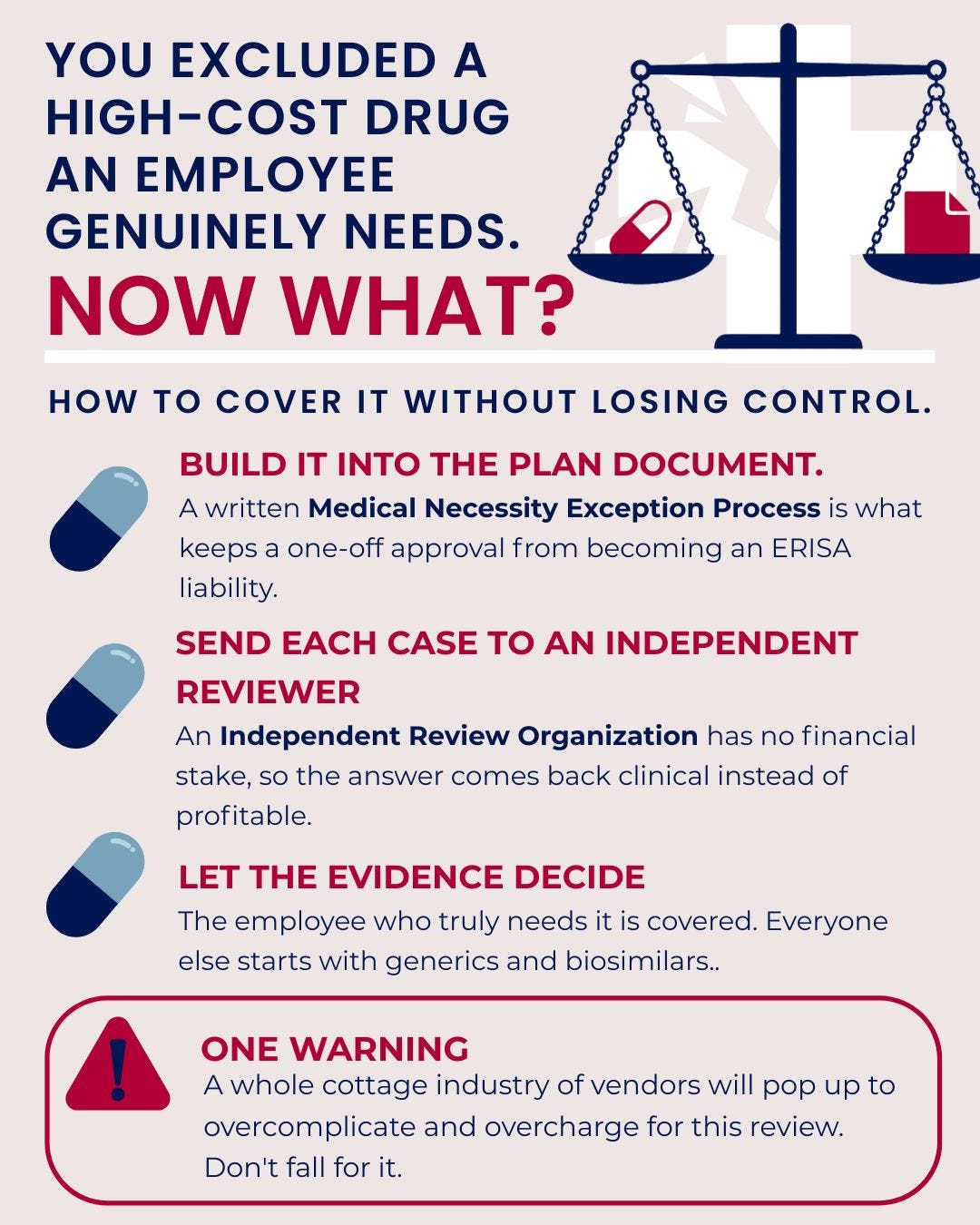
What do you do? There is a simple solution. You do not make an ad-hoc “exception” yourself because doing so would create a dangerous legal precedent under ERISA. Instead, you build a strict Medical Necessity Exception Process directly into your plan document.
You then commission a quick and easy review by an Independent Review Organization (IRO). My company, Amaze Health, is completely independent for a reason. This is an example of that reason. Independence is vital in a healthcare industry has eschewed independence for vertically integrated (and obfuscated) profit.
If the independent clinician says your employee genuinely needs the brand-name drug, your plan covers it. (A warning here: a whole new cottage industry of vendors will try to pop up to overcomplicate and overcharge for this exact review process. Don’t fall for it).
As the employer, you control the process, not the medical license. You strip the decision-making power away from the black-box PBM and put it in the hands of unconflicted science. This forces patients and their doctors to try generics and biosimilars first, knowing that the only way to get the brand name is through hard clinical evidence.
Why “Formulary Management” isn't just another name for "Prior Authorization"
At this point, a skeptic might ask: “Wait, if a drug is excluded but a patient can still get it through a medical review, isn’t that just a prior authorization?”
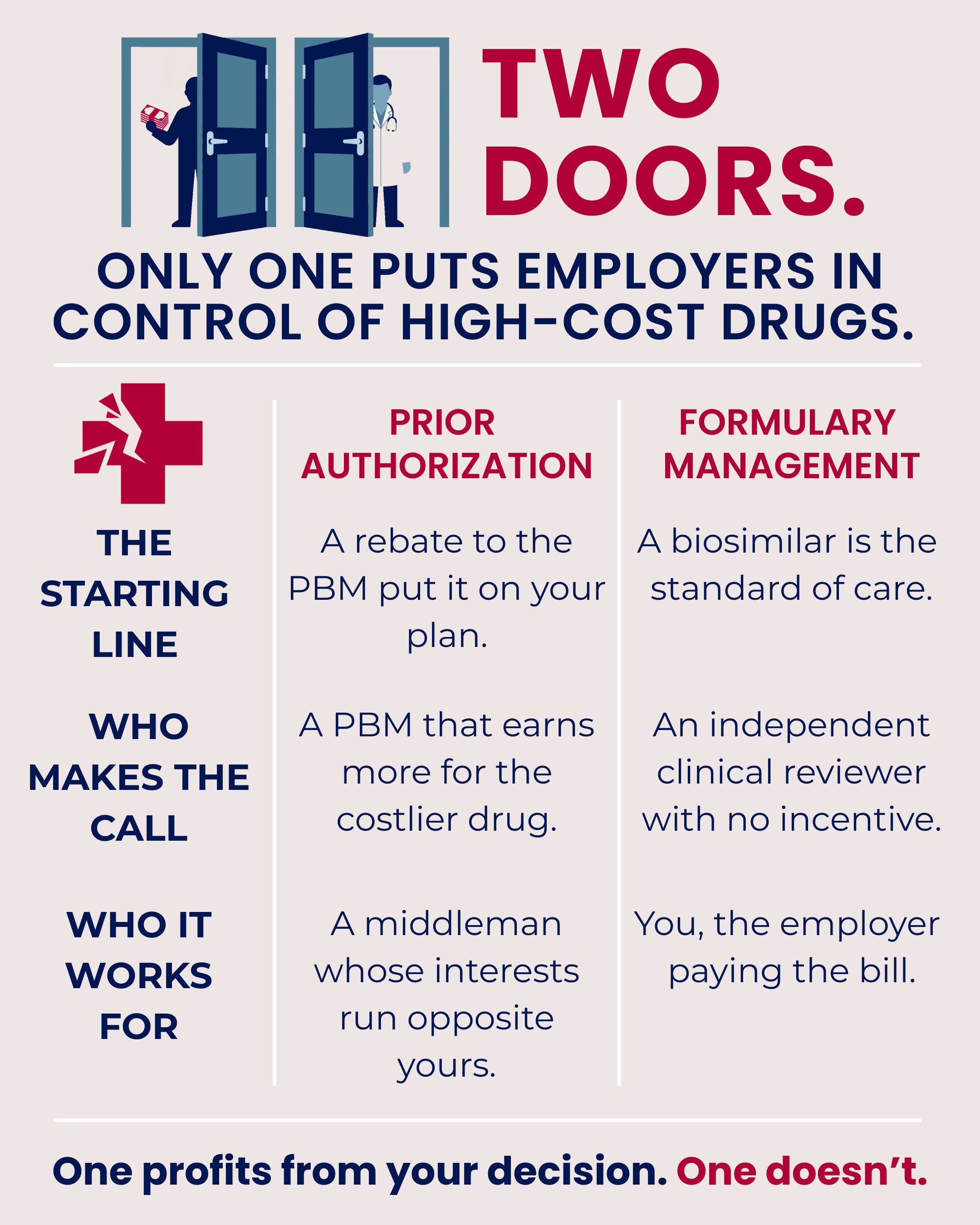
No. It is a fundamental shift in control and financial incentives. Here is why Active Formulary Management is the exact opposite of a PBM’s prior authorization maze:
The Starting Line (Included vs. Excluded): In a traditional PBM model, the expensive brand-name drug is on the standard formulary because the manufacturer paid a massive rebate to put it there. The PBM then throws up a prior authorization roadblock to artificially limit access while still collecting the rebate. With an actively managed formulary, the high-cost drug is completely excluded. You aren’t playing a game of gated access; the drug simply isn’t covered because a biosimilar is the standard of care.
The Incentive (Rebates vs. Reality): PBM prior authorizations are not strictly clinical; they are deeply financial. A PBM will routinely use a prior authorization or step-therapy rule to steer a patient away from a cheap generic and toward a more expensive brand-name drug simply because the brand-name pays the PBM a higher rebate. An independent medical review commissioned by an employer has zero financial conflicts of interest.
The Controller (The Middleman vs. The Fiduciary): Relying on PBM prior authorizations means abdicating control to a middleman whose financial interests are directly opposed to yours. Moving to an exclusion-and-exception model puts you back in the driver’s seat.
The rise of the active sponsor
Employers must realize that PBMs will never willingly hand over this level of control. To execute this strategy, you must fundamentally change how you buy drugs. You cannot accomplish this through major, black-box PBMs whose revenue relies on the very system you are trying to dismantle.
The days of passively abdicating responsibility to a broken system are ending. The future belongs to the Active Sponsor—employers who take active management of their own healthcare supply chain and uncompromisingly curate their own formularies.