



For decades, policymakers and industry leaders have touted value-based care (VBC) and risk-based payment models as the cure for America’s healthcare woes. These concepts dominate conferences, white papers, and legislative agendas. But let’s be honest, they’re distractions—red herrings that divert attention from real solutions. Worse, they create inefficiencies, waste resources, and ultimately reduce access to care while transferring wealth from patients to bureaucracies.
The U.S. healthcare system is the most expensive in the world, consuming more than $5 trillion per year. Layer on top of that the cost of implementing VBC and risk-based models—consultants, compliance systems, and analytics platforms—and you have a bureaucracy that rivals the clinical enterprise itself.
Market engineering is a flawed premise
If market engineering worked, we’d have solved housing affordability with “value-based mortgages” or food insecurity with “risk-adjusted grocery pricing.” Imagine charging more for processed foods because they pose higher health risks. We couldn’t even regulate sugary soda in New York City, yet we think we can redesign the entire healthcare economy. Crazy, right? Welcome to America!
Efficient markets don’t come from government tinkering. They emerge from competition, transparency, and consumer choice. Every time we layer on artificial constructs like VBC, we distort incentives and stifle innovation.
What is value and who decides?
The term “value” sounds noble, but who defines it? Regulators? Insurers? The AMA? History offers one answer: customers define value, and in healthcare, that means patients. It seems the Chairman of the Senate Healthcare Committee has similar questions.
Is value a cure at any price? Is it three extra years of life that bankrupt a family? Or a few more months of painful survival? These are deeply personal questions, not actuarial calculations. Yet VBC frameworks often prioritize payer ROI over patient autonomy, while ignoring the “voice of the customer.”
Even the Centers for Medicare & Medicaid Services acknowledges the complexity: its new models aim for 100% Medicare beneficiaries in accountable-care relationships by 2030, but fewer than half of U.S. primary care physicians currently receive VBC payments. Let’s hope they figure out that it’s a nonsensical path before it goes too far.
The bureaucracy burden
Risk-based models create entire industries devoted to managing risk, calculating trade-offs, and gaming metrics. Hospitals hire teams to optimize coding and negotiate shared savings. Consultants thrive on the complexity. Meanwhile, patients wait longer for care because providers are busy meeting documentation requirements.
Perhaps most importantly, there’s no evidence that VBC models work at scale. Imagine if it turns out to be untrue, what does that mean for economics? I believe it would totally upend economics as we know it.
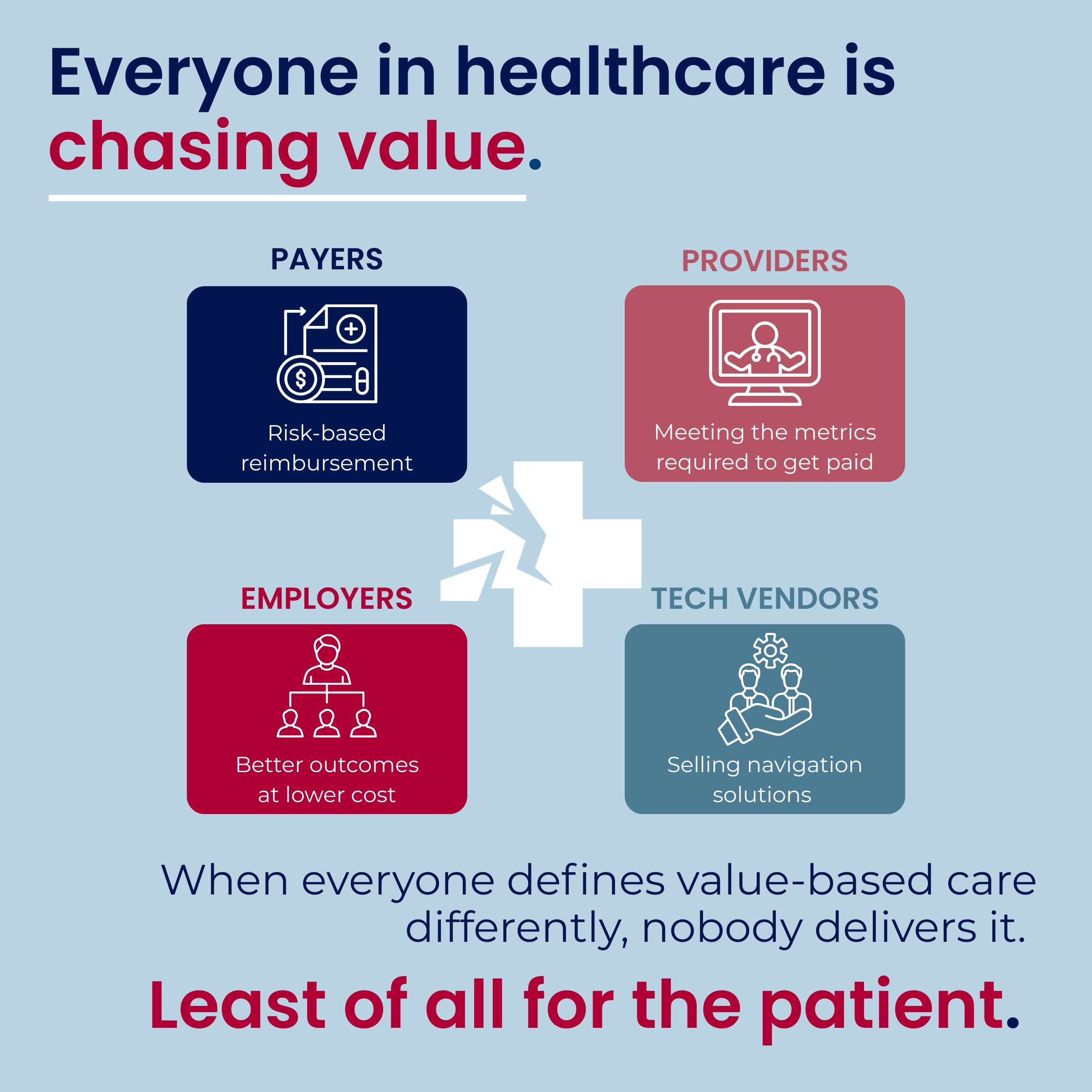
The American contradiction
America’s economic strength lies in free markets. Yet healthcare is the least American part of our economy. It’s dominated by regulation, opaque pricing, and engineered payment schemes. Until we restore market principles such as price transparency, consumer choice, and competition, we’ll keep chasing illusions instead of solutions.
Healthcare reform should not be an exercise in market engineering. It should be a recommitment to the principles that built America: freedom, choice, and accountability. Until then, “value-based care” will remain what it is today—a well-intentioned but misguided experiment that costs too much, delivers too little, and distracts us from the true problem.