


If you listen to the breathless enthusiasm of tech evangelists, hospital administrators, and insurance executives, you might believe that Artificial Intelligence (AI) is the ultimate silver bullet for the American healthcare crisis. We are told that AI will streamline workflows, cut administrative costs, and return the joy of medicine to doctors.
But this unbridled optimism suffers from a fatal blind spot. To understand what is about to happen, we must draw a hard, unforgiving line between two fundamentally different concepts: AI in Medicine and AI in Healthcare.
Medicine is the clinical science of healing. Healthcare, on the other hand, is the multi-trillion-dollar business and administrative bureaucracy of coding, billing, and insurance that governs how medicine is paid for. And while AI is poised to perform absolute miracles for the former, its unintended consequence will be the devastating financial optimization of the latter.
The miracle of AI in medicine
There is no denying the miraculous potential of AI in clinical medicine. Machine learning algorithms can analyze complex protein structures in seconds, identifying novel molecular targets in days rather than decades. AI is accelerating the development of breakthrough medical devices, training surgical robots to be more precise, and spotting early-stage tumors on radiology scans that the human eye might miss.
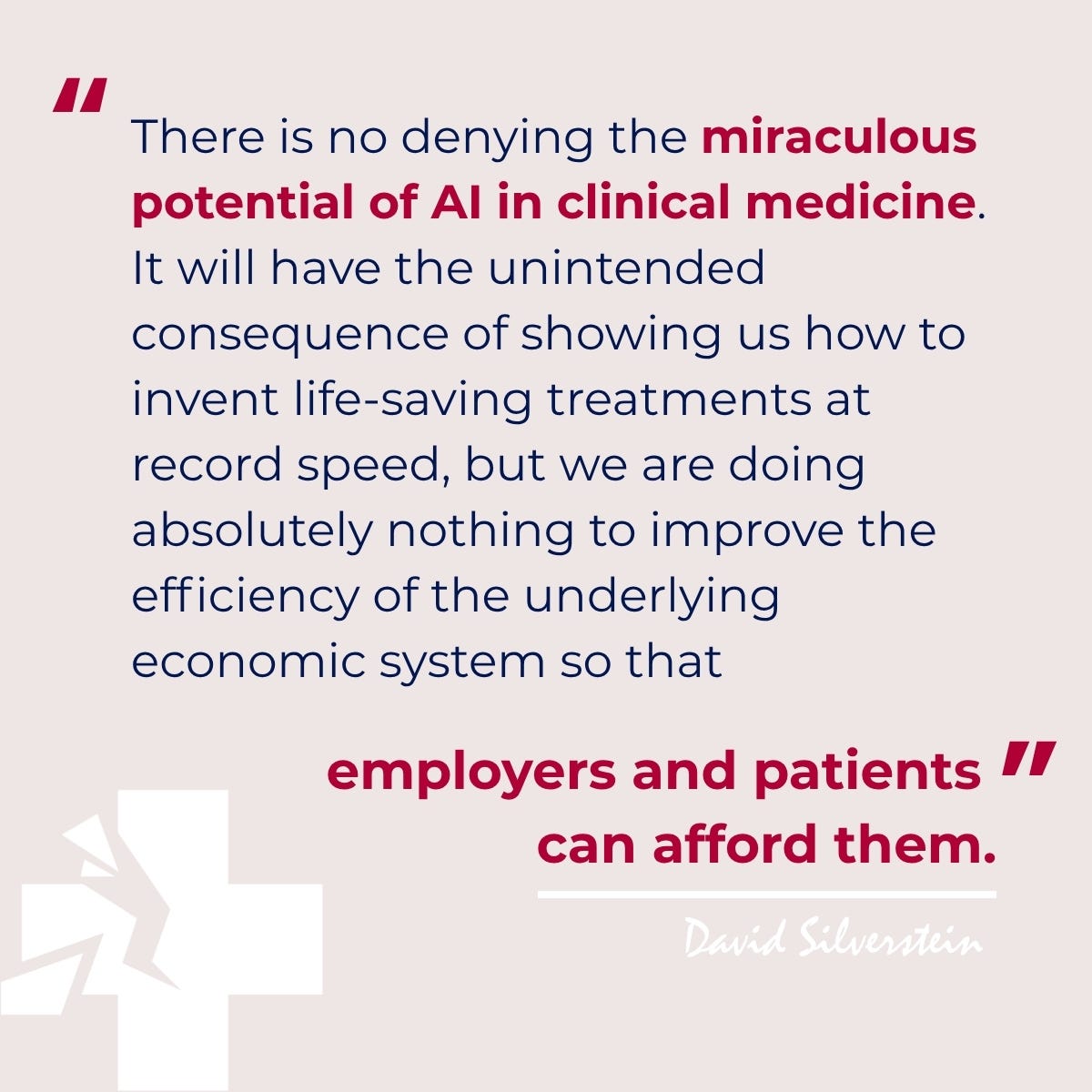
We are going to invent better drugs and cure diseases faster than ever before, but here is the fatal catch: We are grafting these brilliant clinical advancements onto a hyper-inflated, parasitic payment engine. AI will have the unintended consequence of showing us how to invent life-saving treatments at record speed, but we are doing absolutely nothing to improve the efficiency of the underlying economic system so that employers and patients can actually afford them.
The tollbooth economy
As I outline in my book, The Lean Health Plan, the U.S. healthcare system is not a true free market. It is a transaction engine built almost entirely around friction. It is an economy of administrative tollbooths where insurance carriers, Pharmacy Benefit Managers (PBMs), and hospital billing departments extract a margin every time a patient interacts with the system. Up to 50% of every healthcare dollar is consumed by administrative waste, opacity, and bureaucratic bloat.
In a normal, competitive market, technology drives operational efficiency, and that efficiency forces prices down for the consumer. But American healthcare completely lacks the competitive characteristics that ensure savings are passed onto customers. When you introduce a hyper-efficient AI tool into a system designed to maximize revenue, the system does not magically decide to pass the savings on to the patient or the employer. Instead, it uses the technology to become a more efficient extractor of wealth. The well-organized coding, billing, and insurance industries are going to use AI to supercharge their profit margins.
Weaponized upcoding (a warning from PwC)
If you want evidence of how this is already playing out, look no further than PwC’s recent report, Medical Cost Trend: Behind the Numbers 2027. Every year, PwC forecasts the primary drivers of healthcare inflation. For 2027, their number one cost inflator is “AI-enabled revenue optimization.”
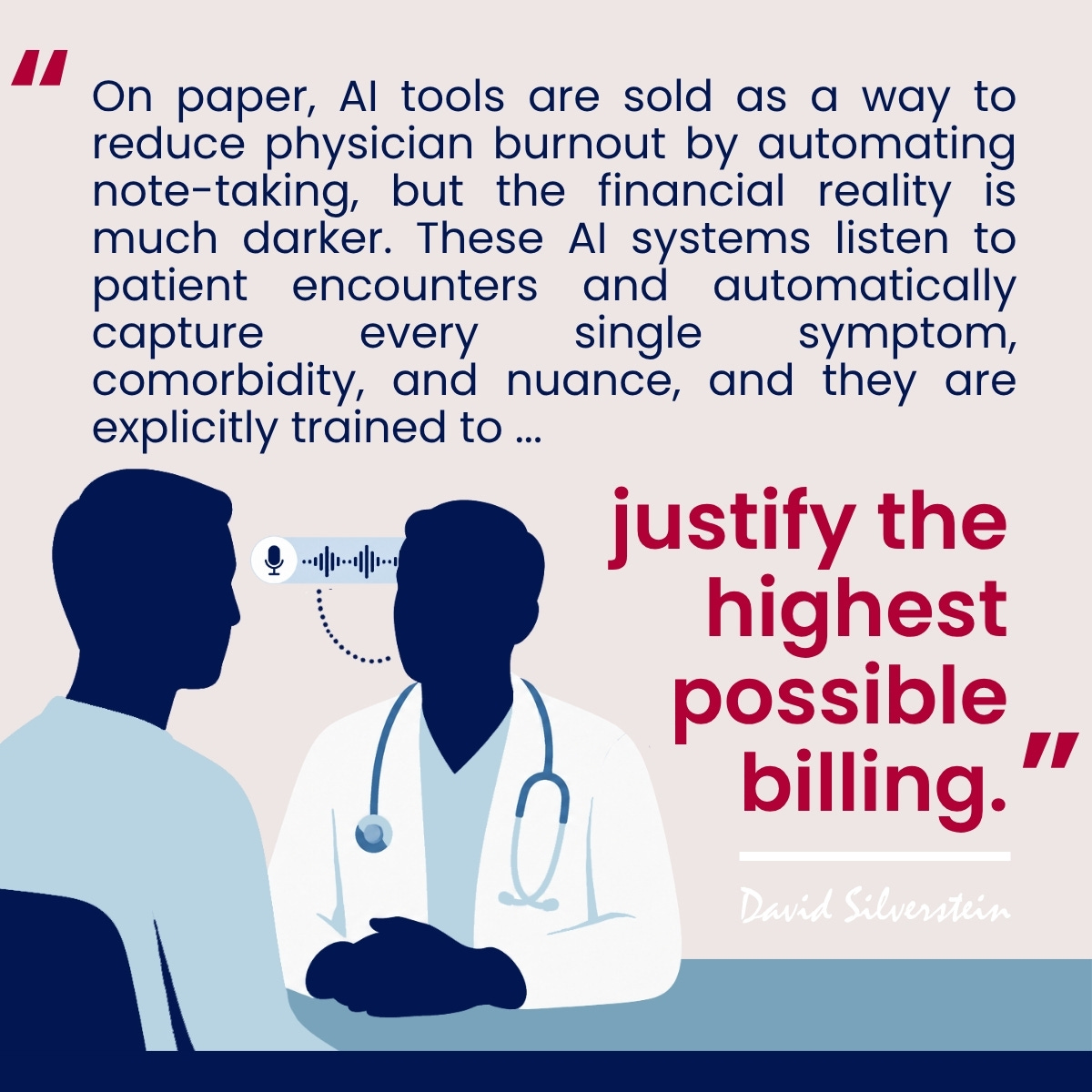
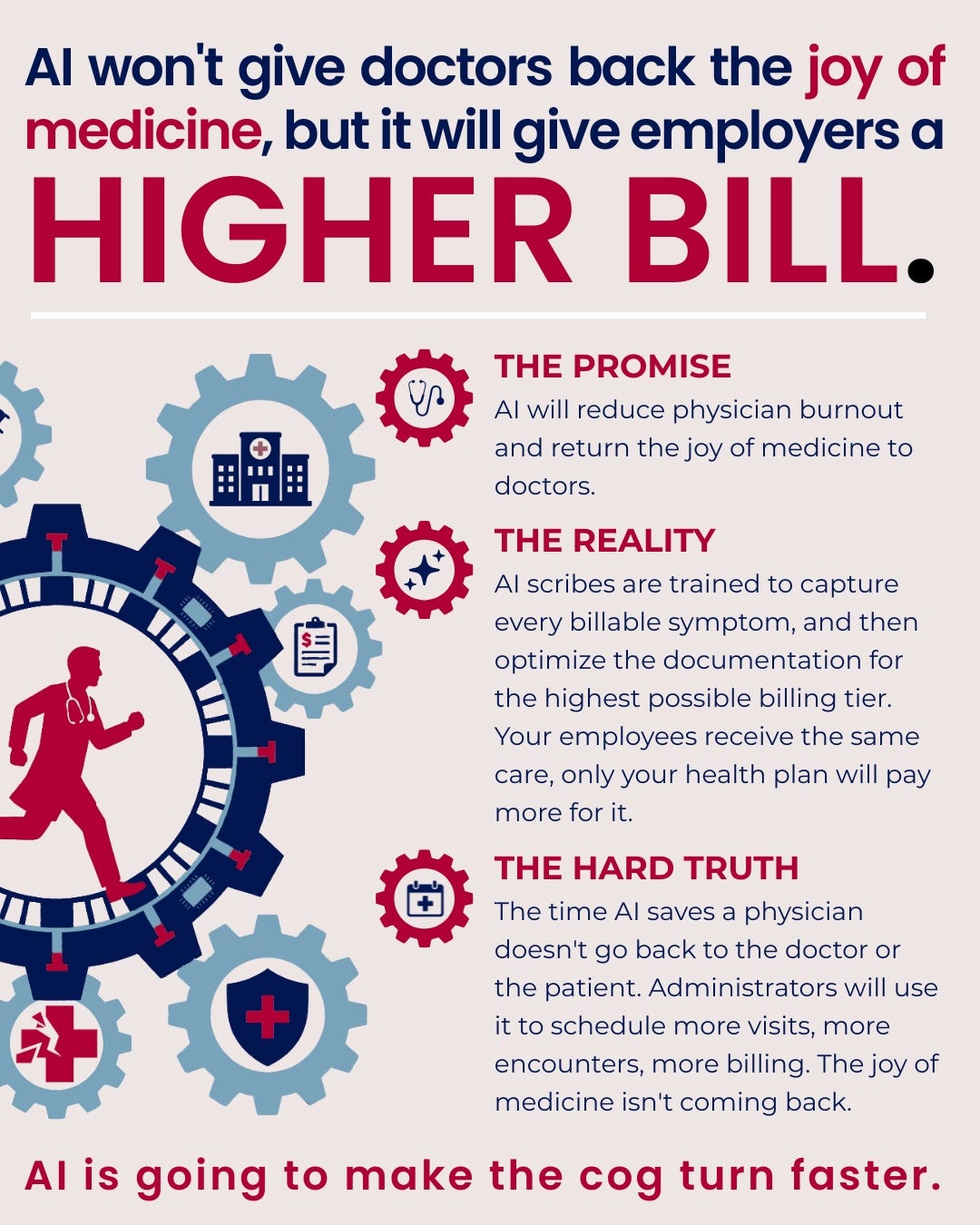
According to the report, hospitals and medical providers are rapidly adopting AI-powered ambient scribes and clinical documentation tools. On paper, these tools are sold as a way to reduce physician burnout by automating note-taking. But the financial reality is much darker. These AI systems listen to patient encounters and automatically capture every single symptom, comorbidity, and nuance. They are explicitly trained to ensure that every conceivable diagnosis and modifier is perfectly documented to justify the highest possible billing.
The PwC report highlights early evidence that hospitals using AI scribes are seeing a measurable increase in Relative Value Units (RVUs) billed per encounter—a key driver in the billing equation.
While the underlying clinical work does not change, the argument will be made that, “doctors are finally getting paid for what they do.” Yet the patient will not receive a higher intensity of care and whether one views this as appropriate reimbursement or system-wide cost inflation doesn’t matter; for employers and patients it means the “allowed amount” billed to the health plan or patient will increase. Providers are using artificial intelligence to ensure every code with every modifier is used to systematically maximize revenue for every single visit, leaving employers and patients to foot the inflated bill.
The myth of the "efficient" doctor
This brings us to the most seductive lie currently being sold to the American public: the promise that AI will “free up” doctors. Proponents claim that by automating administrative burdens, doctors will finally be able to slow down, step away from their keyboards, and spend more meaningful, face-to-face time with their patients.
Do not fall for it.
In a fee-for-service, revenue-cycle-obsessed system, a more “efficient” doctor does not mean the price of seeing a doctor comes down, and it certainly does not mean your doctor will sit and hold your hand for 45 minutes. The administrative machine does not tolerate idle time.
If an AI scribe saves a physician fifteen minutes of charting per hour, hospital administrators and private equity practice owners are not going to let that doctor use those fifteen minutes to build a deeper patient relationship. They are going to use that newfound efficiency to increase throughput. More efficient doctors just means doctors will be pushed to see more patients, schedule more appointments, and bill for more codes with each passing hour.
Unintended consequences
The ultimate beneficiaries of healthcare AI will not be the sick. The winners will be the massive hospital conglomerates and the large incumbent insurance organizations (which, as I explain The Lean Health Plan, are not insurance companies at all).
For the insurance carriers and administrators, more billed codes mean more transactions flowing through their proprietary clearinghouses. It means higher gross charges, which allows them to boast about larger “network discounts” and collect richer administrative fees. Because the system is insulated from true free-market competition, there is no mechanism to ensure that the operational savings generated by AI are passed down to the American worker or the corporate balance sheet.
Artificial Intelligence is merely a force multiplier. When you hand a powerful tool to a brilliant clinical scientist, they will cure cancer. But when you hand that same tool to a bloated, monopolistic administrative bureaucracy, they will use it to build a more efficient tollbooth.
AI is going to show us how to invent incredible drugs and keep people alive longer than ever before, but until American businesses step up, demand transparency, and rip the friction out of the legacy payment system, AI will just be the newest weapon used to redirect resources away from clinical care toward administrative activity, triggering ever more toll payments. We cannot fund the clinical miracles of tomorrow if we are suffocating under the AI-optimized administrative waste of today. Medicine will advance, but without structural reform, “healthcare” will bankrupt us all.